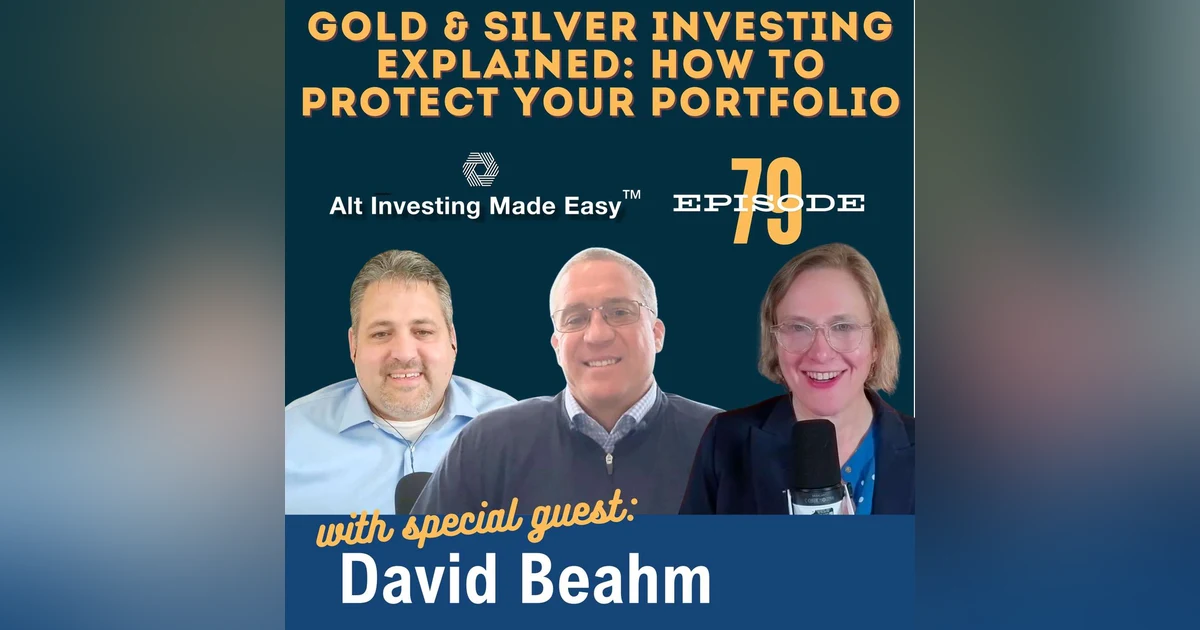
E79: Gold & Silver Investing Explained: How to Protect Your Portfolio


Gold Investing: How Precious Metals Protect Your Portfolio
Gold investing isn’t about chasing returns; it’s about protecting what you’ve already built. In this episode, we break down how gold and silver function as portfolio insurance, why physical ownership matters, and how precious metals behave across inflationary and deflationary cycles. You’ll learn how experienced investors think about allocation, risk, and long-term value—without the noise or hype. If you’re actively deploying capital and want a clearer framework for diversification, this conversation will help you make more confident, informed decisions.
Top 5 Takeaways for Investors
1. Gold is insurance—not a growth asset
Gold isn’t meant to outperform stocks’ it’s designed to protect capital when other assets are under pressure.
2. Physical gold removes counterparty risk
Owning gold outright eliminates reliance on institutions, platforms, or intermediaries; you control the asset directly.
3. Gold performs in both inflation and downturns
Unlike most assets, gold can hold or increase value during both inflationary and deflationary environments.
4. Silver demand is being reshaped by AI
Industrial demand, especially from AI data centers and technology infrastructure, is creating a new long-term demand floor for silver.
5. Allocation—not timing—is what matters
Successful investors focus on strategic allocation (typically 5–20%), not trying to perfectly time entry points.
Notable Quotes
- “Gold and silver don’t have counterparty risk—you actually hold the asset.”
- “It’s not about what gold does tomorrow. It’s about where it is in 10 or 15 years.”
- “Gold is one of the few assets that performs in both inflationary and deflationary cycles.”
- “Our investors aren’t trying to trade gold—they’re trying to protect wealth.”
- “Diversification isn’t just different stocks—it’s owning assets that don’t move together.”
- “If you’re even considering gold, you already understand its real value.”
- “Don’t try to time it. If you’re buying for the long term, now is the right time.”
- “Gold isn’t about performance—it’s about peace of mind.”
Chapters
00:00 – Introduction to gold investing & guest background
02:30 – Why physical assets still matter in a digital world
04:20 – Physical gold vs ETFs and counterparty risk
05:40 – How gold performs in inflation vs deflation
06:30 – Market signals: interest rates, central banks, sentiment
07:30 – Silver investing and AI-driven demand
09:00 – The misunderstood opportunity in U.S. gold adoption
10:00 – Gold’s role in portfolio diversification
12:30 – Recommended allocation: 5–20% framework
15:30 – Bullion vs rare coins (numismatics) explained
17:00 – Coins vs bars vs rounds: what to buy first
21:00 – How to choose a reputable gold partner
23:00 – Red flags: pressure tactics and guarantees
25:00 – Storage options: home, vaults, global access
26:30 – Liquidity and how selling works
29:00 – Behavioral investing: emotion vs strategy
32:00 – When is the “right time” to buy gold?
35:00 – Final thoughts and how to get started
Credits
Sponsored by Real Advisers Capital, Austin, Texas
If you are interested in being a guest, please email us.
Podcast Production by Red Sun Creative Studio, Austin, Texas
Disclaimers
“This production is for educational purposes only and is not intended as investment or legal advice.”
“The hosts of this podcast practice law with the law firm, Ferguson Braswell Fraser Kubasta PC; however, the views expressed on this podcast are solely those of the hosts and their guests, and not those of Ferguson Braswell Fraser Kubasta PC.”
© 2026 AltInvestingMadeEasy.com LLC All rights reserved
TRANSCRIPT:
AIME Episode 79 Transcript
Sarah Florer (00:00.774)
Welcome to Alt Investing Made Easy. Today, we're pleased to present an episode that has not only our guest, David Beahm, from Blanchard and Company. He's the president and CEO. But also we have our colleague, Anthony Carrano here. He works with us here at AIM, and he's here to...
David Beahm (00:02.99)
Correct.
Sarah Florer (00:29.024)
helped me conduct the interview today. So thanks for joining also Anthony, but also definitely David. We're really excited today to talk about precious metals and how that fits into the landscape of alternative investments. So welcome.
David Beahm (00:42.616)
Great, thanks for having me.
Anthony Carrano (00:45.62)
Excellent, Wallace. We get started. David, really excited to have you on. Why don't we kick things off? Just tell us a little about yourself.
David Beahm (00:53.026)
Sure, my name's David Boehm. I'm the president and CEO of Blanchard & Company. Blanchard's been around for over 50 years. Last year was our 50 year anniversary and we got started. It's a great story. It gets people interested in the topic. Back in 1974, when President Nixon was being inaugurated, our founder, James Blanchard, hired a plane to tow a banner behind it, much like you see on the coast, Gulf Coast or the East Coast. And it says, know,
$11.99 all you can eat lobster. Instead, he had legalized gold on the back of it and he flew it around the inauguration through the duration of it. Nowadays, I'm not sure you can even have a plane take off in that area. You'd have some serious problems. So yeah, right. That's about it. Right. Sure. So he had the pilot flying around the entire inauguration and shortly thereafter, President Nixon.
Anthony Carrano (01:23.616)
Yeah
Anthony Carrano (01:34.326)
No. Well, it could probably take off. think getting it. Yeah.
Sarah Florer (01:39.232)
You
David Beahm (01:50.19)
decided to allow retail investors like us to own gold because prior to that, since 1933, it was illegal for us to own gold. So Jim Blanchard and James Blanchard really pioneered the industry and 51 years later, here we are.
Anthony Carrano (02:07.574)
Thank you, yeah, that's just wild to think about that as that citizens weren't able to own this. I think that's something that just gets lost in just in today's conversations and I know, you know, won't get kind of into the weeds about the history of that because I'm sure there's plenty, you have some articles and things on your website kind of talking a little bit about the histories and, you know, how some of these things came to be.
Where, well, excellent. Well, let's kind of jump into some things talking about the macro and market context. In today's digital age, there's a lot of opportunities for investing. But when it comes to gold and silver, why do you believe a tangible assets like gold and silver still matter in the digital-first investing world?
David Beahm (02:57.431)
Well, certainly digital assets have taken investment world by storm. And it's certainly a younger demographic as well. Typically people that are investing in precious metals are a little older, a little bit more conservative. But at the end of the day, what you're really looking at is counterparty risk with digital assets and gold and silver just don't have that. We at Blanchard, actually ship the gold and silver to the individuals. So they actually have it, they hold it.
use the analogy of like Uncle Scrooge, like they actually open the box and there's the gold. So you don't have to worry about counterparty risks. You don't have to worry about a promise. You don't have to worry about a platform. You don't have to worry about the power going out. So while it's not necessarily just old fashioned, it's just functional. That's what precious metals and tangible assets are. They've been around for over 3000 years and they'll be around for the next 3000. So it's just a...
Anthony Carrano (03:29.814)
Ha
David Beahm (03:53.569)
just a staple in somebody's insur... I mean, in their portfolio that offers a warm blanket of insurance.
Anthony Carrano (03:57.238)
Mm-hmm.
Now, could you, I want to piggyback a little bit because you, there's a really a key word I think, you know, I want folks to understand is you said when they actually hold it, right, there's not the, with the counterparty risk. Now I know there's, because you I mean you have like there's gold and silver ETFs and these, there's still like the digital, they try to digitize, you know, like investment opportunities off the precious. Can you talk about why it's a little, it's important, you know, about when you hold it and not having that counterparty risk?
David Beahm (04:30.839)
Sure, but the best way of owning gold to us is the true proxy, which is the physical gold. So you can look it up in the Wall Street Journal and see what your gold is worth every day. Some of these ETFs, mining shares, futures, yes, they will track the price of gold, but you do have third party, counterparty risk. And let's take a mining share, for instance. What if the mine collapsed? What if the CEO does something that the investors don't like or the stock market doesn't like?
ETFs, their costs associated with that. When you own physical gold, the cost are insurance and storage. With ETFs, you've got to pay the C levels, you got to pay to market it, you got to pay an accounting staff. So there's certain other aspects of the gold market where you can get into it. It's been great. We love ETFs because it creates a lot of demand for the product to get in and out of the products, but our investors aren't looking to get in and out. Our investors just want a long-term hold.
maybe to pass down to another generation and the way to do that best is really holding the physical gold in your hands.
Anthony Carrano (05:28.81)
Mm-hmm.
Anthony Carrano (05:32.886)
So let me ask you this, how should investors interpret gold's behavior during like both inflationary and deflationary cycles?
David Beahm (05:44.462)
So you've always heard that gold is an inflationary hedge and it is and it brings confidence as well. When you have deflationary times, that means things aren't going that well, which means that you look at gold again as a safe haven asset. So gold's one of the few assets that actually performs pretty well during both inflationary periods and deflationary periods. Again, it just offers that protection. And we've all been told that it's...
inflationary hedge and we don't really think about it from the deflationary side but it performs just as well during those cycles as well.
Anthony Carrano (06:17.878)
What signals would you say like you watch to determine when gold is undervalued or overbought?
David Beahm (06:28.469)
I think one thing you can look at is you can look at real interest rates, which we look at. You can look at what's going on with the central banks and just overall investor sentiment. What are they worried about right now? And you really can take your pick on what you need to be worried about. But if you have aggressive central bank buying out there, which you do, I we have the highest amount of central bank buying that we've had in a long time.
Anthony Carrano (06:46.666)
Mm-hmm.
David Beahm (06:54.413)
And so when that money floods into the marketplace and grabs all the physical gold that you hand, that's a signal to buy. But really right now what you're looking for is what's the future look like? And we don't have the crystal ball, but we do see what's on the horizon. And we realize that yeah, gold's up in terms of value, but where does it actually, what's the runway? And it's got a long way to go, I think, with everything going on.
Anthony Carrano (07:07.488)
Mm-hmm.
Anthony Carrano (07:15.57)
Mm-hmm What about I'm gonna ask the same question, but just swap out one word, right? Yes, Swap out word gold with silver. So like what signals do you watch determine when silver is undervalued or overbought?
David Beahm (07:31.799)
So silver is a little bit different than gold because it has the industrial aspect to it. So when the overall global economy does well, because of everything that's going on with that, silver does perform well. But one thing you have to look at silver right now is let's see what's going on in the United States. AI farms, they're being built all over the place and all of them need silver. So that's a new demand that we haven't had from silver. So it's not just investors in the traditional.
industrial demand, but now you're having all of these AI server farms being built and they need silver to actually open those and have them functional.
Anthony Carrano (08:08.315)
Mm-hmm, and that's what I'm gonna compound. think what is it correct me your day, but I think it's what we've had five or six straight years of Inventory shortages on the industrial side for silver. I think is really affecting, you know price
David Beahm (08:24.356)
Yeah, mean, silver was range bound for a long time and, we got to 100 and we backed off a little bit, but I don't think that a lot of people realize how much demand is truly out there from the industrial side of things, not just the investor side of things. And that's where you see the demand going. And really, the sky's the limit. I mean, if we're going into the AI age and all these major tech companies are investing what they're investing in AI, that's a floor for silver for sure.
Anthony Carrano (08:40.244)
Mm-hmm.
Anthony Carrano (08:54.122)
Mm-hmm.
David Beahm (08:54.252)
But it probably likely is going to be a nice jolt of demand with a limited supply.
Anthony Carrano (09:01.686)
I have one more kind of question here around like just talking about like with the macro and market context and that is what would you say just in your experience is like the most misunderstood trend shaping the future of gold and silver?
Sarah Florer (09:02.303)
Hmm.
David Beahm (09:16.896)
I think you have to look at what's going to happen in United States. It's misunderstood about just gold in general. We have such a small percentage of our population that own gold, whereas the Asians and the Europeans, that's a staple to them. So if investors in the United States realize the value of gold in their portfolio, then now all of we have retail demand, we have strategic positioning that we haven't had before.
And it's not just speculation. It's pure demand on somebody that understands what gold and silver can do for their portfolio. And if US investors had a real understanding of the values of gold and silver in a portfolio, you're going to have a lot of demand.
Anthony Carrano (10:02.506)
Mm-hmm. Mm-hmm. Yeah, I think...
Sarah Florer (10:04.298)
Which would be good for the gold price. If you already have gold.
David Beahm (10:06.888)
Absolutely, and silver as well. Yeah, right, right, but it's a backstop.
Anthony Carrano (10:07.882)
Yeah.
Yeah, well too, just a comment on that about the backstop. you know, it's one of the things that really kind of turned the lights on for me in my journey was not so much getting preoccupied with looking at price, right? Because price is relative, right? I mean, just price of anything, right? But really understanding, I like the word you use about hitting on like with the value and that there was a formula that was just talked about to really understand like a good value
of something is divide that price of X over that price of Y. So for example, divide what's the Dow divided by the price of gold to get that Dow gold ratio or do the same thing of like gold to oil or whatever asset, the price of X asset divided by the price of Y asset and understand and see those both the historical trends and then with what that current number is to really get a good sense of what
the real value of something. So I don't know that was that was something that really impacted me. Do you find like do you get into those type of conversations with folks?
David Beahm (11:22.044)
We really, we don't. mean, we can certainly talk to them about the technical side of gold, but most of our investors come in because they realize they need protection and they're not necessarily worried about where the price is right now or where it's going to be tomorrow. It's a long-term, like I mentioned, it's a long-term asset to hold. And yeah, we can talk about, we can even talk about the gold and silver ratio. But yeah, all those ratios that you mentioned, I think can play important role in determining the value. But most of our clients aren't really looking for.
Anthony Carrano (11:31.146)
Mm-hmm.
David Beahm (11:50.029)
What is their true value of gold right now? They want to know what the value of gold is going to be in six years or 10 years or 15 years. And it's going to be hard for anybody to convince me that what we have going on in the world right now, the goal is not going to be higher in 10 or 15 years.
Anthony Carrano (11:54.038)
Mm.
Anthony Carrano (12:03.316)
Mm-hmm. That's right.
Sarah Florer (12:05.696)
You know, it's interesting because we can't give official investment advice here, obviously, regardless of whether we're investment advisors or not. here, for the sake of education, what would you just say generally for investors? How should they think about including some gold in a diversified portfolio?
David Beahm (12:28.364)
So I think that the main thing is to look at gold and silver is not something that's going to outperform the stock markets or the bond markets, which you're really looking for is an asset that will protect it. And those assets are correlated. And yeah, you can say, well, I'm diversified. I have beverage stocks, and then I have lumber stocks, and I have restaurant stocks. But in reality, they are correlated to some degree. So by diversifying outside of the stock and bond market and into the precious metals market,
Sarah Florer (12:52.168)
Mm.
David Beahm (12:58.028)
you actually are providing yourself with a traditional asset that performs when other assets are under pressure and they offer you that insurance policy that don't necessarily correlate with the stock market and the bond market. you can kind of take back in 2008, gold acted exactly how it was supposed to. So was $900, the financial crisis hit, liquidity crisis, people liquidated gold, they raised cash, gold went down to 700.
and then performed exactly how it should when people were uncertain. It rose and rose and that's exactly what the precious metals grouping of assets does. It provides protection and insurance and liquidity.
Sarah Florer (13:32.565)
Hmm.
Sarah Florer (13:42.944)
So just as an aside, know, it's interesting because I've spent a lot of my life in Asia, in Asia or adjacent to Asia. And I think it's such a part of the cultures there that gold has value and gold is part of your investment. Gold may be your future retirement plan, actually. And that's built into culture from the time you get married or the time you're born, really, and people start giving you gold.
And so just as a bit of an aside, I really think that you're so spot on and relevant to making sure that the message gets out to everybody here in the United States about the value of gold in your asset, in your portfolio. Whether you do your asset allocation in your portfolio, or whether you have a professional who does that for you, I think this is a conversation probably worth having with your investment advisor. And just on that note, what do you typically see can be a good percentage to have in a portfolio?
David Beahm (14:40.553)
It depends. What we like to do at Blanchard is you're assigned a portfolio manager, kind what you were talking about, your investment advisor. We wouldn't take the place of that investment advisor. We would just help with the allocation of bullion. So we typically recommend five to 20 percent if you're conservative, maybe a little bit lower than 20 and make it in five or 10 percent range. But really what you want to just have, we would never recommend people liquidate their entire investment portfolio and buy gold and silver. That's just not smart. We preach diversification.
Sarah Florer (14:46.495)
Right.
Sarah Florer (14:51.519)
Yeah.
Sarah Florer (15:00.543)
Hmm.
Sarah Florer (15:07.839)
Hmm.
David Beahm (15:08.939)
And that's what we do. So we're looking for an individual to look at between 5 and 20 % of the precious metals complex. And that provides that insurance policy that I keep referring to.
Sarah Florer (15:20.916)
Yeah, exactly.
Anthony Carrano (15:23.616)
So on that note, for someone kind of new to precious metals, and you know, there's a lot of options, right? Even within this space, there's a lot of different things to kind of choose from, mainly between, you know, bullion investing and then the numismatics. How would you explain the difference between the two for someone who's just now looking into this?
David Beahm (15:47.916)
So bullion is exactly what we've talking about. It's gold and silver and it directly moves with the spot price of gold and silver. Numismatics are what we call rare coins and we'll refer back to that story I was talking about the plane over the inauguration. Well, prior to 1933, you could own gold and so all these numismatics, all these rare coins are pre 1933. So yes, they do have gold content in them, but really what makes them valuable is the history about them.
the quality of out them, scarcity of them. And so those are how you would diversify within the gold and silver space. So a lot of our investors come in and buy, you know, one ounce gold American Eagle or silver Eagle or 10 ounce gold bar, something that they can understand right out of the gate. And then we explain the benefits of diversifying within our own asset complex. And that's when we start discussing.
rare coins and how they can add value to portfolios.
Anthony Carrano (16:48.246)
Well then even within maybe if we could kind of lean towards talking about like with bullion right between there's You've got like the coins the things that are produced by the mints You've got the bars and then you've got the rounds maybe can you like briefly like touch on what the difference is between each one of those and You know why why? Without you know, maybe why there's one would look at one over the other
David Beahm (17:17.515)
Sure, so you're right. So each mint around the world produces their own one ounce gold coin at least. There may be fractional gold pieces, there may be a little bit larger than one ounce. And then you have the bullion coins, are, excuse me, the bullion bars, which are exactly what you think about. It's what you see in the movies, the 400 ounce bars, 100 ounce bars, the kilo bars. And then you have the rounds, which are generally private mints that...
that make their own one ounce coins. So they're stamped one ounce so know what you're getting. And they have a different unique design on them. But really what we for a brand new investor, we look to see what are you trying to accomplish? And then we decide what asset you need to be in. So typically to start out, our investors are looking at a one ounce Gold American Eagle, which is minted by the United States Mint.
and they guarantee it for weight content and purity. When you get into the rounds and stuff like that, you really need to make sure that you're dealing with a regular company because you want to make sure that you're getting exactly what you think you're going to get. But if you buy something that's from the mint, then you know what you're getting and the United States Mint stands behind. And of course, we stand behind it as well. I think what, speaking, a one ounce gold coin is what you want to start with.
We also have fractional pieces and just a quick side note, like our fighter pilots, whenever they're flying missions, they have fractional gold pieces that are tied in their flight suits in case something happens and they have to eject them there in enemy territory and they've got to get back. Gold's a recognizable currency around the world. And if you need to get safe haven somewhere, then gold's way to do it. So it's a very unique asset that it does provide us
Anthony Carrano (18:49.813)
Yeah?
Anthony Carrano (18:56.778)
Yeah.
Sarah Florer (18:57.417)
Hmm.
David Beahm (19:01.951)
and your listeners with protection, but it's also used as a currency around the world. So we can't forget about that, but that's about it.
Anthony Carrano (19:06.346)
Yeah.
Anthony Carrano (19:11.466)
Okay.
Sarah Florer (19:11.516)
Just on that note, would say I have some like 22 karat gold from my own wedding and in Dubai, you can just go into most stores and sell it. You just you can immediately liquidate it like you don't have to go to a bank or through a broker. It's because the jewelry stores themselves are the brokers because they take it and make jewelry from it.
David Beahm (19:21.651)
Right, it's very liquid asset. Yes.
David Beahm (19:29.481)
Right.
Right. And just as a side note, because you brought it up, just the confidence for your listeners, we do buy things back from our clients. So whatever the market is at particular point when they're ready to sell, we're here to buy the coins back from them at that market price. And a lot of people in the industry, I won't say competition, a lot of people in the industry don't do that. They're focused on selling the gold to the client and then that's the end of the transaction. And because we assign you with the portfolio manager
Sarah Florer (19:40.937)
That's a good point.
Sarah Florer (19:49.098)
Mm-hmm.
Sarah Florer (19:56.319)
Hmm.
David Beahm (20:01.599)
The lifetime value of the client is the relationship that we build with them. And they have the same person, we've got portfolio managers that have been here for 30 years, and they have the same clients assigned to them. So when you call us up, not only do you, you you're talking to blanchard who's 50 plus years old, but you're going to talk to somebody that's very well-versed. And like I was saying, we're going to be here to buy it back when you are ready to sell.
Anthony Carrano (20:05.194)
Mm-mm.
Anthony Carrano (20:11.487)
Mm-hmm.
Anthony Carrano (20:24.874)
And that's why you've been around for 50 plus years. You take care of your customers.
Sarah Florer (20:25.12)
That's interesting.
David Beahm (20:27.518)
Right, right. We complete the circle. We complete the circle.
Sarah Florer (20:27.848)
Yeah, really? Yeah, no, makes sense, though. I mean, especially if you believe in the value proposition of gold, you probably don't mind buying it back.
Anthony Carrano (20:33.824)
What if I
David Beahm (20:40.434)
No, not at all, because we have somebody on the other end that's ready to buy it from us.
Sarah Florer (20:41.504)
You know? Yeah, yeah.
Anthony Carrano (20:44.258)
That's it. it. What, so if I may, Sarah, there's, you you started talking a little bit about the, like the questions that you would ask, you know, potential customer. Maybe if you can elaborate a little bit more and like what's the recommended, someone's new to this looking at it like a decision criteria for how they would approach investing in gold and silver.
David Beahm (21:08.618)
I think the most important thing is the reputation of the firm. We all watch TV, we all see various personalities talking about gold and buying gold. We choose not to do that. What we want to do is we want to talk to the individual, figure out what their goals are and recommend them. So look at the firm's track record, make sure that they're being transparent with you, make sure they're willing to educate you because a lot of people don't understand gold and we take the time to figure out.
what goals are and then explain to them how we can accomplish those goals. And I think that that's a little bit different than most people in the industry where there's websites out there that you can buy. You might even be able to buy a little bit cheaper from, from Blanchard, but you're not going to get the service. You're not going to get the reputation. You're not going to get that confidence that I think you need when you're, when you're contemplating spending a good portion of, I mean, five or 10 % of your portfolio, regardless of the dollar amount, that's still a lot of money. So you need to make sure that you're dealing with the reputable firm.
Anthony Carrano (22:01.398)
Mm-hmm.
David Beahm (22:04.491)
Check references if needed. But most importantly, if you get a bad feeling, don't do anything. Call us, call my answer. We'll tell you if you're getting a better deal. The problem is it's an ounce of gold. How much better of a deal can you actually get? And you have to look at the longevity and who's gonna be there to buy back from you. So all those things are something you really need to look for when you're ready to partner with somebody.
Anthony Carrano (22:20.662)
Mm-hmm.
Sarah Florer (22:28.692)
And I think that leads us to like what a few red flags might be. like to kind of approach that from the other direction and actually risk is something we always want to talk about when we talk about the goodness of an asset because every asset has some kind of risk, whether it's your process of engaging with the acquisition of that asset or whether it's the asset itself. But in this case, I think what you're saying is what would be some red flags just in terms of a potential partner or who you might
you know, what you might want to hear from somebody that's leading you in a good direction versus a bad direction.
David Beahm (23:02.602)
Well, let me start with what you don't want to hear. You definitely don't want to hear high pressure sales tactics. You don't want to hear guarantees about performance. So those are two red flags that you really want to watch out for. As far as what you do want to hear, you want to hear, want to build a relationship with you. I want to understand what you're trying to do. I want to partner with you. I want you to know that I'm going to be here. Here's my number.
Sarah Florer (23:07.369)
Yeah.
David Beahm (23:25.802)
I've been around for this many years, the firm's been around for this many years. I when gold gets hot, you do have pop-ups. we remember in 2008 and 2009, the cash for gold companies that were really on the street corners in tents trying to buy people's gold back. And I'm sure they're a reputable company, but they weren't there for very long. then firms just disappear, but we haven't. So I would encourage anybody that's looking for precious metals as an investment.
Sarah Florer (23:33.216)
Hmm.
David Beahm (23:53.461)
to just make sure you have a good feeling about it from not just the person that you're talking to at home, but do research. Find out online, look at reviews, look at what your peers have done. And nobody wants to be sold anymore. Everybody wants it to make their decisions. So do all the research yourself before you're ready to call. And then you'll have the questions. And then you've liked the answers to the questions, that's the firm that you should work with.
Sarah Florer (24:00.468)
Mm-hmm.
Sarah Florer (24:12.368)
Are there any certifications to look out for that might lend credibility to someone when they're coming in the gold industry? Some industries don't have specific ones, but...
David Beahm (24:23.092)
So we, there's partnerships within the industry that people are members of, but that's about it. I really think that it's really up to the individual to do the due diligence and to be comfortable with it. And it sounds like I'm, know, kind of being a little scary here, but all I want to do is make sure that your listeners have the appreciation for, hey, you want to do business with somebody that you can trust. That's the bottom line.
Sarah Florer (24:28.788)
Mmm.
Sarah Florer (24:47.85)
Right. Yeah. Which is, you know, what we all aspire to advise people probably at least around this table. Right.
Anthony, you want to move on?
Anthony Carrano (25:00.682)
Yeah, I was going so you know after someone has you know they're you made a purchase what if someone made the safest ways to store their gold and silver?
David Beahm (25:11.338)
So because we actually ship our metals to our clients, that is a question that needs to be answered. So there's a number of ways to do it. A home safe, insured, a safety deposit bank. There are depositories around the world that we partner with that if a client doesn't want to take possession of their gold, we can help them set up storage and insurance at various places around the world.
Some people want their gold outside of the financial system in the United States, which is fine. We're happy to help with that. Some people want to put it in their sock drawer. That's fine too. But I do think that it is important to think about what you're going to do with the gold once you open it up and you have that warm fuzzy feeling about owning that warm blanket. But what are you going to do with it once you have it in hand? And so I would highly recommend either a home safe or jewelry and whatever else or
or an institution that has the professional vaulting.
Anthony Carrano (26:10.07)
Mm-hmm. And I know you've kind of touched on this a little bit, but I know, you know, people are thinking about, for those that maybe aren't, you know, holding on like long-term generational wealth preservation, but would look to try and, you know, have an exit at some point about the liquidity. Now, I know you mentioned you guys would buy it back. You have that posted on your website.
David Beahm (26:33.033)
We do. We have a buyback guarantee that anything that we sell, we will buy back at the then, and that's the keyword at the then current price. But yes, we make this full circle. It's liquid. You ship the coins back to us as soon as we receive them, we strike the price and then we literally send you a check. And it's really that easy. So compared to real estate and other alternative assets, this is certainly a lot more liquid.
Sarah Florer (26:41.087)
Mm-hmm.
Anthony Carrano (26:42.644)
Mm-hmm.
Anthony Carrano (26:52.33)
Mm-hmm.
Anthony Carrano (27:00.575)
Hmm.
Sarah Florer (27:01.002)
Right. And just out of curiosity, who do you use for this shipping?
David Beahm (27:07.221)
We use two primary carriers. We use USPS, registered and insured, which is the safest way, but it's also the slowest way. And then we also use UPS either overnight or second day. But both partners have been with us for a number of years. the shipping has been an issue for the entire United States. But the partnerships that we have with them
Sarah Florer (27:10.772)
Hmm.
Sarah Florer (27:23.818)
Mm-hmm.
David Beahm (27:33.667)
I are different than most. And because we're shipping what we're shipping, we're not shipping a t-shirt, we're shipping precious metals. So the box is different, the method of shipping is different. And the most important thing is that it gets to our clients and they take possession of it. And we make that happen every single time.
Sarah Florer (27:37.736)
Right, exactly.
Anthony Carrano (27:38.228)
Ha ha ha ha.
Sarah Florer (27:51.648)
So out there, if you buy some gold from David, keep the box. In case you want to sell it back.
David Beahm (27:55.932)
Right, right. It's, yeah, it's, and actually, it's funny you say that because what we do do for our clients is we will actually mail them empty boxes. So they can put it back in there. And so you don't have to worry about finding a box that's secure. have the different packing tape than most people. So we send all that to the client. And when they're ready to sell it, they box it back up, send it to us. And we know that it's safe and secure because it's exactly how we would ship it out.
Sarah Florer (28:22.354)
It's funny because sometimes I think these logistical details are actually what it takes for people to get comfortable, like how you can see it fit into your real life, right? Receiving gold, able to move it around, what to do exactly.
David Beahm (28:34.665)
I think the comfort level is what a lot of people are uncomfortable with. So they really don't understand how it works. You take an economics course in college, the last day before the bell rings, they mention gold and silver and then everybody runs out because you're talking about stocks and bonds forever. That's what you're supposed to do. You're supposed to reinvest dividends. And then by the time you get to retirement age, you're great. Well, that may have worked for a number of years, but it doesn't work anymore. And so we try to make it as easy and seamless as possible.
Sarah Florer (28:51.776)
Yeah.
Sarah Florer (28:59.252)
Yeah.
Anthony Carrano (28:59.253)
Mm-hmm.
David Beahm (29:03.475)
for investors to come in, we figure out what they wanna do, they fund the account, we strike the price, we send them the gold, and we just reverse that when it's time for them to sell. So there's no mystique or mysteriousness about it. It's very easy. And the comfort level that your listeners should have is that you should be comfortable with it. We've been doing it for 51 years. We can help you figure out what your goals are and we can get it to you safely.
Sarah Florer (29:24.96)
Hmm.
Sarah Florer (29:29.3)
Yeah.
Moving on, we've talked a little bit about this and I think you've touched on it, but there are always behavioral and psychological drivers that go into people and their money and their assets and everything. so during certain times, some people are making emotional decisions. It's not really investment decisions. It's not necessarily using a bunch of ratios or mathematical decisions. And especially there will be a cultural influence too, which I think, you know, if you're already from a culture that
used to put all the money under the mattress and in gold and bills, then you're going to turn back to that when it's uncertain. you know, it sounds like the interesting thing with gold is that there is all that emotional decision making when it's uncertain could actually potentially act in your benefit. Like maybe it's a rational reaction and gold is the asset, one of the options of an asset to land in.
David Beahm (30:30.129)
Yeah, when there are times of uncertainty, investors look for something that gives them confidence. And it can be a central bank, could be institutions, it could be the retail investor. What people are looking for is what can I have that I can go to sleep at night and be comfortable that when I wake up, things are going to be okay. And gold and silver are one of the few assets that actually give people, investors, a peace of mind during uncertain times. it's, mean, can go back however long you want to go back and you can just see the trend that when there's uncertainty, the price of gold performs.
Sarah Florer (30:46.282)
Mm-hmm.
Sarah Florer (30:59.881)
Mm-hmm.
David Beahm (30:59.977)
Now there may be a liquidity event that where in like 2008 where the price of gold did go down a little bit, but then it acted exactly like it's supposed to. So during times of uncertainty, you're looking for something that's going to give you confidence and time and time again, gold and silver do that for portfolios.
Sarah Florer (31:16.19)
When do you think is like an emotional decision that you've seen made that maybe wasn't a good choice to make and get to get into precious metals?
David Beahm (31:23.145)
I think if you try to chase prices, I think that's kind of the hardest thing to do. know, they say catch a falling knife. There's a lot of truth to that. But really, what are you trying to do? If your entry point is on day one, and you're waiting for the price of gold to go down $100, $1,000, $200, your ultimate goal is that you want to hold it long term. And so you shouldn't be necessarily concerned about where it is right now. And if it's at $4,500 and it goes to $4,000, guess what? I'm calling you.
Sarah Florer (31:28.447)
Mm.
Sarah Florer (31:44.19)
Yeah.
David Beahm (31:51.529)
And I'm gonna say, look, we can dial a cost average down a little bit. So if you have some more money to put into the marketplace, let's dial a cost average and get your cost from 4,500 to 4,250. So there are certainly some times where investors are hesitant because they did I miss the boat? Is it too late? Is it too early? You just wanna get into the market. Don't worry about timing. If you're even considering gold.
Sarah Florer (32:00.522)
Mm-hmm.
David Beahm (32:15.367)
You know what the real value is. It's not what's gonna happen tomorrow or yesterday. It's gonna be what happens in the next six months, six years, 10 years. That's what we try to explain to our clients.
Sarah Florer (32:21.493)
Yeah.
Sarah Florer (32:25.844)
Yeah, that makes sense.
Anthony Carrano (32:29.786)
So now David, I know this has been great. Really appreciate your time and your insights. This has been fantastic. And I know, I mean, you've been featured on a lot of other major financial media. What tends to be the most common question you get about gold?
Sarah Florer (32:33.02)
Yeah, it's so much information that's good.
David Beahm (32:35.219)
Good, good, I'm glad to hear that.
David Beahm (32:48.457)
I'll piggyback on what we were just talking about. The biggest question I get is, is now a good time and how do you do it? I those two just come, I mean, nobody knows how to buy physical gold. So when's the right time? Yesterday, right? Or today or tomorrow. The right time is what are your financial goals? What are you trying to accomplish? And what are you looking for? Are you looking for a five, 10 or 15 year plan? You want to pass it down to one generation to the other?
Anthony Carrano (33:04.82)
Hahaha!
David Beahm (33:17.416)
If you're looking to buy and hold, now is the right time. It doesn't matter what happened yesterday or today. It really matters what you think is going on in the future. And then the how to buy, we've already explained how easy it is. You you fund your account, we send you the gold. And then when you're ready to sell it back, you send it to us and we send you a check. So it can be a little bit concerning because you're sending money and you're waiting for something in the mail and it could be a lot of money in most cases. But we've been here for a long time. when you're...
Anthony Carrano (33:20.906)
Mm-hmm.
David Beahm (33:45.545)
when you're confident enough to say, hey, I'm ready to buy gold and you're confident enough to invest with Blanchard and company, I can assure you those two things right there are, you're gonna feel good about it.
Anthony Carrano (33:57.428)
Excellent, excellent and... Ogoe-za!
Sarah Florer (33:58.632)
I have actually just a little bit of it aside, sorry, before we continue. Do you have a title process? is it specific? I know you gold bars are numbered and coins would be numbered, but this is all based, it's going to be all based on a document that evidences weight, right?
David Beahm (34:12.841)
So there is no real, yeah, there are serial numbers on bars, but in reality, what you wanna do is you wanna buy, I'm gonna go back to this again, you wanna buy from somebody that you have confidence in so you know what you're getting. Yeah, there are people out there, just like every industry, they will take advantage of people. So you really wanna make sure you're doing your due diligence, because there isn't a certification or you don't get a piece of paper that says, oh, I own this gold. So it's...
Sarah Florer (34:26.578)
Hmm. Yeah.
Sarah Florer (34:39.967)
Right.
David Beahm (34:42.256)
It's he who has the gold rules, right? The new golden rule. And so when you have that gold in your hand, that's yours. You own it and that's your title right there.
Sarah Florer (34:43.966)
Yeah.
Sarah Florer (34:50.612)
Right, it's physical possession.
David Beahm (34:52.946)
Yes.
Anthony Carrano (34:55.898)
Well, what, David, I know you've been at this a minute. What keeps you passionate about the gold and silver after decades in the industry?
David Beahm (35:08.456)
So I think that the performance one and then helping clients achieve what they're trying to achieve. I mean, we have 400,000 clients that we've helped over the years. And we hear stories of the relationship that they built with our portfolio managers. And the fact that when we walk out of here, well, mean, hell, we're open 24 seven really, but we walk out of here at the end of the day and we've helped somebody achieve their financial goals. That's what we're all about. We're building relationships. We happen to sell gold.
And we think goals and asset for people to have, but the relationship that we have with the clients that we have, it's gonna be second to none in the industry for sure. I would put myself up in our company up to a lot of financial companies that are trying to help people. do it, but we do it better.
Anthony Carrano (35:55.958)
Excellent, excellent. And as we wrap up, what's some of the best ways for folks to, if they want to reach out and connect either with you or with Blanchard, what's the best way for them to do that?
Sarah Florer (35:56.799)
Yeah.
David Beahm (36:09.064)
Sure, if you're contemplating it and you want to get some more information, our website, lanchardgold.com, we've got everything you're going to need to make your decision there. And then just call our 1-800 number and talk to one of our portfolio managers. It doesn't matter what the size of the investment is. We treat everybody as one person, as one individual, and we want to help achieve those goals. Our number's on our website, but it's 800-880.
Sarah Florer (36:23.252)
Mm-hmm.
David Beahm (36:36.104)
gold. How about that? 800-880-GOLD. 4653. We must have got it 51 years ago when we started.
Anthony Carrano (36:37.396)
Hahaha!
Sarah Florer (36:37.664)
Somebody got in there quick
Anthony Carrano (36:43.082)
That's it, man. Excellent.
Sarah Florer (36:43.104)
Well listen, we'll put all those details in the show notes and I think also just I would say as a cautionary measure, make sure you talk to a human from Blanchard. I would assume that there are people out there trying to market to buy gold through a website and that was probably not a good idea I would assume. All right, so let's see, any more questions? David, anything else you want us to touch on?
David Beahm (37:11.11)
No, this has been great. think we covered exactly what I would like to have covered and I appreciate you guys having me on and giving me an audience to explain the benefits of owning gold.
Sarah Florer (37:16.088)
great.
Sarah Florer (37:20.426)
Well, and it's really great to meet someone who's so articulate about it because I do think, like you say, it's all about education.
David Beahm (37:29.352)
Yes it is, I agree.
Sarah Florer (37:30.596)
All right, well, thanks so much for being here. Everyone, this is David Boehm from Blanchard Company. And thanks for joining us today on this episode of All's Investing Made Easy. We'll see you next time. See ya.