E75: How Fiduciary Advisors Use Alternative Investments to Build Smarter Portfolios
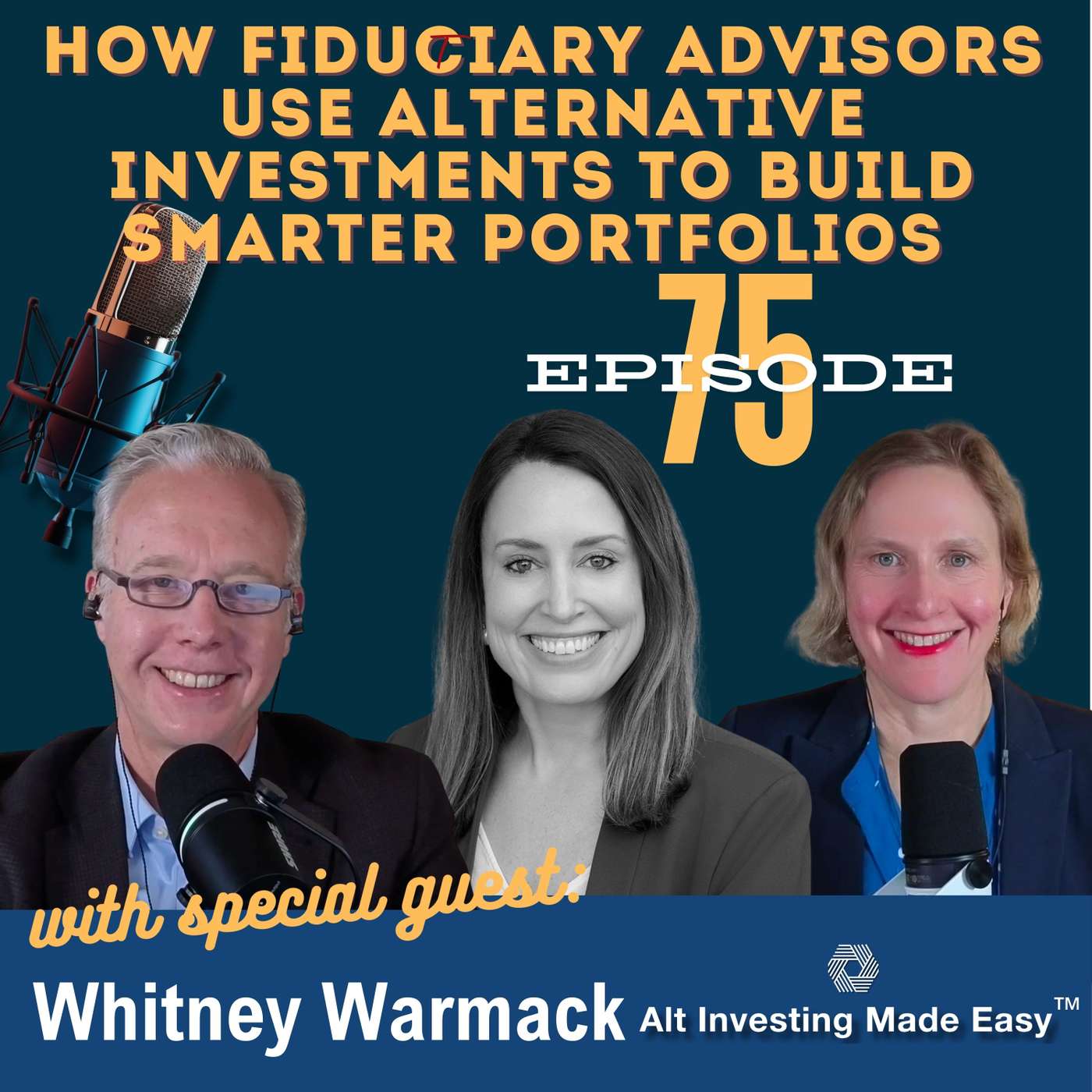


What does a fiduciary financial advisor actually do—and why does it matter for investors allocating capital today? In this episode of Alt Investing Made Easy, Sarah Florer and Roland Wiederaenders sit down with wealth advisor Whitney Warmack to explore how independent advisors guide families through complex financial decisions. From understanding alternative investments and liquidity risk to navigating the emotional realities of wealth and generational planning, this conversation demystifies how thoughtful advisors help investors align capital with long-term goals, values, and disciplined decision-making.
Meet our Guest: Whitney W. Warmack, CFP® Managing Director, Client Advisor at Caprock
Whitney Warmack, CFP® is a Managing Director and Client Advisor who brings deep empathy and clarity to every financial relationship she serves. Shaped by her family’s experience navigating financial decisions without guidance, she is driven to be the trusted first call for clients facing life’s most important choices. Whitney blends technical expertise with a holistic understanding of each client’s full financial picture, ensuring advice that is both strategic and deeply personal. At Caprock, she is proud to be part of a nimble, client-first team committed to delivering truly personalized wealth stewardship.
Connect with Whitney on LinkedIn: https://www.linkedin.com/in/whitney-warmack/
Top Takeaways
1. Fiduciary Advisors Put Clients First—Legally and Structurally
Independent investment advisors operate under a fiduciary duty, meaning they must act in the client’s best interest, not simply recommend “suitable” products. Transparent fee structures and independence from broker-dealer incentives allow advisors to prioritize investor outcomes.
2. Alternative Investments Are Becoming Essential
Private equity, private credit, and other alternatives are no longer niche allocations. As more companies stay private longer, investors who ignore private markets may miss large portions of economic growth.
3. Liquidity Is the Defining Risk in Alternatives
The biggest difference between public and private investments is liquidity. Investors must understand that alternative assets may lock up capital for years—even when they offer higher return potential.
4. Wealth Management Is Part Strategy, Part Psychology
Money is deeply emotional. Advisors often act as financial coaches, helping families manage anxiety, decision-making, and the psychological shifts that come with wealth.
5. Generational Wealth Requires Intentional Parenting
Many wealth creators worry about passing wealth responsibly to their children. The solution often involves allowing the next generation to experience responsibility, discipline, and even financial struggle so they develop resilience.
Notable Quotes
- “A fiduciary advisor isn’t just recommending suitable investments—we’re legally required to find what’s best for the client.”
- “If you’re not investing in private markets today, you’re missing a large portion of the overall economy.”
- “The biggest risk in alternative investments isn’t always performance—it’s liquidity.”
- “Money is emotional. Everyone has a relationship with money shaped by their experiences growing up.”
- “Your advisor should never feel like someone selling you something.”
Chapters
00:00 – Meet Whitney Warmack
01:02 – What Is an Independent Investment Advisor?
03:25 – Fees, Transparency, and Advisor Incentives
05:21 – Generational Wealth and the “Five Capitals” Conversation
07:09 – Avoiding the “Ruined by Wealth” Problem
10:23 – Letting the Next Generation Struggle
15:24 – Explaining Alternative Investments to Clients
18:56 – Private Markets vs Public Markets
20:25 – Risks of Bringing Alternatives into Retirement Accounts
24:05 – The Advisor as Financial Coach
26:17 – The Emotional Side of Money
29:18 – Whitney’s Personal Journey into Wealth Management
31:11 – Protecting Clients from Complex Investments
33:24 – Why financial advisors should act as partners, not salespeople
Credits
Sponsored by Real Advisers Capital, Austin, Texas
If you are interested in being a guest, please email us.
Podcast Production by Red Sun Creative, Austin, Texas
Disclaimers
“This production is for educational purposes only and is not intended as investment or legal advice.”
“The hosts of this podcast practice law with the law firm, Ferguson Braswell Fraser Kubasta PC; however, the views expressed on this podcast are solely those of the hosts and their guests, and not those of Ferguson Braswell Fraser Kubasta PC.”
© 2026 AltInvestingMadeEasy.com LLC All rights reserved
We're not salespeople. Advisors should not be salespeople.
Sarah:Yeah.
Whitney Warmack:Yeah. Your financial adviser really as a as a partner or a coach.
Roland:Welcome to Alt Investing Made Easy, where we explore the complex world of alternative assets. I'm Roland, a securities attorney, investment advisor, and your cohost.
Sarah:And I'm Sarah, an investment advisor and corporate attorney, and your other cohost. We'll guide you through real estate, private equity, and more, making complex topics accessible.
Roland:Tune in for insights that empower your financial journey.
Sarah:Let's make Alt Investing easy one episode at a time. Hi, everyone. Welcome. Thank you for joining us here on Alt Investing Made Easy. Today, we're thrilled to bring to you a conversation with our friend, Whitney Warmach.
Sarah:She's a wealth advisor with Caprock, and she's here to talk to us about some of the things she does in the wealth management space. Whitney, thanks for joining us.
Whitney Warmack:Thank you for having me. It's great to be here.
Roland:Yeah, thanks for being here, Whitney. It's always great to talk to a fellow investment advisor and you've been doing this much longer than we have and so we bring you in as an expert. And importantly here, we mentioned to the audience, so Whitney, we talked a little about this before we started that you're an independent investment advisor. And we haven't talked about that a lot on Alt Investing Made Easy and really what that means, what the significance of it is. So I just wanna frame this a little bit for our audience and then quickly we wanna hear from you.
Roland:Whitney, tell us a little about yourself and your background and just wherever you wanna start.
Whitney Warmack:Sure. A lot of times I tell people I grew up in some very glamorous parts of Texas. So Conroe, Texas and Flower Mound, Texas. One knows where those places are unless you grew up I
Sarah:know where Texas.
Whitney Warmack:Okay, you're one of the few. And I really, I started my financial education probably later in life. It wasn't something we talked about growing up in my family. So it was a really kind of a self motivated journey. I originally thought I wanted to be more of a psychologist.
Whitney Warmack:I enjoyed working with people, But funny enough, that really brought me into the more personal finance realm. I enjoy working with families. I started off my career with a small financial planning firm and just found different paths to where I am now, which is in the RIA space as an independent advisor.
Sarah:So Whitney, I think let's get down into, because we just had a nice little chat about what is an independent advisor. And Roland, do you kick that off with, do you want to frame it? And then, you know, from the legal perspective, I suppose, and then we can
Roland:And just to make the distinction for our audience, in my mind, you know, when I hear independent investment advisor, it's an investment advisor that's registered either with the state or with the SEC, but they are not affiliated with a registered broker dealer and that has relevance. And it's a question that you can ask, you know, speaking to our audience members now, when you're evaluating a financial planner and an investment advisor, this is an important question that you should ask. And Whitney is our subject matter expert. So Whitney, maybe explain just the distinction there and then we can get into some of the consequences like we were talking before we hit record.
Whitney Warmack:So one of the things I explained to folks about the difference between working with a broker dealer as part of like a big bank, for instance, or working as part of an independent advisory firm is really the responsibility and the relationship you have with the families, with the clients you serve. And that difference is the fiduciary responsibility. And many people would call themselves a fiduciary. So I try to explain, what does that really mean? And that means that not just because I want to, but I'm also compelled, I am legally required to work in the client's best interest.
Whitney Warmack:And that means that it's not necessarily I just find an investment option that's suitable. It's that I have to find the best investment option that I find is best for the family. And I also think there's a distinction between how an independent advisor charges fees versus how a big bank charges their fees. For instance, Caprock has a singular fee, and that's really important for us to emphasize because we believe that it aligns us with the client's best interest so that we can be agnostic about where we find solutions to really meet their goals. Because I think that when you see where fees are, it can drive and incentivize behavior.
Whitney Warmack:So it's important for us that we charge only one fee to the client. There's no commissions, no hidden fees. It's very transparent. And I think that gives people peace of mind when I explain that difference.
Sarah:I think that makes a lot of sense actually. And I'm recalling having a conversation with somebody almost two years ago about that very same thing, about where do you put the compensation? Particularly, and I don't know actually what range of family, you know, what range of net worth you start with working. But I think particularly when people are serving the client base that's like just beginning to build their wealth, it's really important. Builds a lot of trust when you have basically a fixed fee is what I understand that you're saying.
Roland:I'll just, oh, ahead, I
Whitney Warmack:was gonna specify, it's a percentage of assets under management is typically how we charge the fee. Yeah. Yeah. But we can customize our fee schedule depending on the family. And thankfully, because we have a lot of multi generational wealth, I work with the people that created the family's wealth, but I also work with their children.
Whitney Warmack:And there's an educational component and there's also a level of joy being able to see somebody build their own wealth. It's really satisfying and gratifying to be able to be a part of that.
Roland:You know, Whitney, one thing we talk about on here, I don't know if you're familiar with it. This is kind of a curveball. We could have talked about it ahead of time, but the Five Capitals model from the James Hughes Foundation, are you have you ever heard of that before?
Whitney Warmack:I I've not studied that capital model, but I'd like to learn more.
Roland:Well, it's just the idea that there there are different types of capital other than financial, and then the goal really is, and I I know you've got your own answer to this, but, you know, so frequently wealthy families, they'll be gen one, you know, builds the wealth. Gen two isn't, you know, enjoys the wealth, but they're not the ones that built it up. And then by gen three, all the wealth gets squandered because there's no relationship between gen three and gen one and no continuity. And so that's really what the five capitals model is about. But you've got your own answer to that question.
Roland:You know, Whitney, if I were coming to you as a wealthy family and said, you know, my highest priority is to make sure that the the wealth that I pass on to my grandchildren isn't a burden that they can't bear, you know, rather that wealth will be a blessing. Whitney, help me to achieve that. What's your response to that?
Whitney Warmack:So the families that come to me and they word it a little bit different and they ask me, how do I make sure I don't ruin my children?
Roland:There you go.
Sarah:Oh yeah.
Whitney Warmack:That's a
Sarah:most common question I got. How do
Whitney Warmack:I make sure I don't ruin them? A lot of the families I work with are first generation wealth creators and that's a big concern. They've been so heads down working to create the wealth that a lot of times they worry that they haven't passed on the values that helped them develop that work ethic and to appreciate what they've done for their families financially. So one of the things we talked about, and this is an analogy, I won't probably say it the best way possible, the most articulate way, But I talk to them about like a chicken hatching on a bag, a little baby bird for instance. And it's important for us as parents, A, to not kind of interfere with specific developmental stages that are really hard from a parent perspective, but critical for their development so they can kind of develop their own muscles.
Whitney Warmack:And so financially that might mean that you let your child fail a little bit financially. Perhaps you don't necessarily pay for 100% of their college. You know, there are things and moments in life when you need to let them stand on their own so that they struggle and then they develop the strength and the confidence to know that they will be able to make it through the next difficult period.
Roland:That's really good. I like that answer a lot.
Sarah:It kind And of
Roland:makes we have count instincts as parents, you know, to overprotect our children, Sarah. I mean, you know that much better than me because you're a mom.
Whitney Warmack:Of course, but I think like if you think back to your own life, sometimes you look back and you're like the most difficult periods were those that you look back at fondly because you learned a lot, you grew a lot, you're so proud of how you overcame whatever obstacle that was, whether financially or another thing going on in your life. And I think that as a parent, you have to let your kids develop that. So that's part of sort of the value system and how you will impart both financial wisdom but also just general family values to your children is to allow them to struggle a little bit.
Sarah:You know, I have a little anecdote to share about that typical, that situation. It's a friend actually from Dubai and his father is from Tunisia. His mother is British. And so his father was very successful and sent him off to university in The United Kingdom and bought him a house with three bedrooms. And then he said, I'm not giving you anything else for university.
Sarah:You have this house. You can rent out rooms. You can do what you need to, but you have to pay the bills. You have to do the maintenance. It's yours.
Sarah:And I'm not paying your school fees. And of course in The UK, it's different from here. The school fees are like a few thousand dollars a year. So you gotta work that out. And he was very angry sometimes when he'd share the story of this, but underneath it all, he's also become very financially successful, and he's doing the same exact thing for his kids.
Sarah:So I think that's an example of what you're saying. Like, don't, you know, they have a roof over their heads. Right? It's there's still like some basic things that many other people don't have when you're not from a family of affluence. But at the same time, you gotta make it work.
Sarah:Like you gotta appreciate that you don't get to sit in this gigantic house and have your friends over and have a party all the time. You have to make sure they're paying rent.
Whitney Warmack:Right. And you're already probably fortunate. So it's, I'm still giving you privileges, whether that be value education, just being part of like a healthy, well rounded family, but I don't necessarily need you to be flying first class. You know, there's a little, help them a little bit. You're already helping them being a good parent, but let them have their own struggles for sure.
Sarah:Well, the thing I like You about the did a lot of in The Middle East. Sorry, Roland.
Roland:No, I mean, the thing I like about the story that you shared, Sarah, was that it just reflected the the importance of relationships. And obviously, that father knew well enough that that child was capable of administering that house and driving income from it. And and that's really what's so important is David, our friend David Clafflin said the other day, it's better to have good people and bad papers than good papers and bad people. It's just all about those relationships encouraging people and being really thoughtful about like what you're saying. I like this, Whitney, this direction of not being afraid to let your children fail.
Sarah:Yeah. I think that's actually kind of a revolutionary topic. I know, I mean, Whitney and I have kids approximately same age. Roland has kids, but his are like summer in their twenties and summer in their late teens. And, we can get into that in a minute.
Sarah:Because, one of his daughters is a soccer superstar, and we're gonna see her in the Olympics So one we have to spread the news and tell everybody. But but, but I do think it's it's such a challenge. I know we parents know that, but I still don't think that that happens a lot in elementary school or in middle school, because it does feel like the stakes are so high. Like, oh my God, if I let my kid get an F in this class, it's gonna go on his record. And then he's gonna have to deal with that.
Sarah:And then when he wants to go to a certain magnet school for high school, and then what about university? It's just this constant spiraling of what ifs of that concept of letting your kids fail. But on the other hand, it's so critical because then they're gonna become adults who can't, you know, even if they're affluent enough to not have basic need concerns, they're, you know, where's the satisfaction or gratification that comes from living life, especially when you get a leg up in the beginning and get to start from there. I don't know if it's hard for clients to hear you when they say that, but I would imagine they understand, but then, you know, the mama bear comes out.
Whitney Warmack:We have ongoing conversations for that very reason. I think it's similar to any other type of discipline. There's ongoing conversations to help exercise that discipline, whether that be maybe you don't buy the kid the house or maybe you let your kid take out a loan for school, for college or medical school, and you don't necessarily inform them that you'd be very happy to help them with that loan later. I think more so than anything else, I think that you're really giving them a disservice by taking all struggle away from them. Every time someone falls down and gets back up, they're building a level of confidence and they're less anxious and fearful of falling down in the future.
Roland:Yeah. Yeah, I think about-
Whitney Warmack:feel like I
Sarah:need to come to you. All right, Roland.
Roland:Well, as I was growing up, I really appreciate the fact that I paid for my own education, and I was driven to do that by hunger. You know? I mean, I I I saw that I had a vision of something greater, you know, that and I knew, you know, someday I could be an attorney, you know, and I had to go to college to get a law degree, and you have to get a law degree to pass the bar. So, you know, these were things that that, you know, I was just very internally motivated to achieve, but it was all really from a place of hunger, you know. And I think that if circumstances that had been different in my life where, you know, I I I grew up in opulence and, you know, just never was given the chance to fail, and I guess I really do have to thank my parents.
Roland:You know, that's what it was for them coming from pretty humble circumstances, but they would encourage me to go out and do things and then, you know, but also allow me to fail. And and I think I I can look back and and be very thankful while I maybe didn't get the financial education that I wanted, there were fundamentals that were trained in me that did lead me to have a career and that's necessary. I'm gonna graduate from law school or whatever you're doing. But Whitney, the next thought, and Sarah, maybe you have another thought, I thought we could kinda ask you the standard question, because we're talking about alternative assets here, alternative investments. The question, Whitney, I come to you, you're my potential investment advisor.
Roland:I'm interviewing you. How do you talk with clients about alternative assets? But Sarah, do you have any I mean, what do you think? Do you have other things think we should think about?
Sarah:Yeah, we'll kind of want to come back to the differentiator we discussed earlier too. So we'll circle back to that.
Whitney Warmack:When I think about alternative investments, especially by introducing it to a family that's kind of a new idea for them, what does that really mean? So I liken it to just a new way of categorizing investments. Typically we talk about the difference between public equity, fixed income, and then I liken private equity. It's just like public equity, but you're not going be able to see it traded on an exchange. We talk about illiquidity risk, and it's important for us to inform clients about the additional risk about alternative investments and really define what each category is.
Whitney Warmack:So private credit, what does that really mean? And the biggest sort of differentiator we talk about is illiquidity. So even if something is an interval fund and has potential quarterly liquidity, there's also potential that that could be gated and it's not really liquid. So to understand the additional risk you're taking, but the potential for higher rewards is important. And one thing we emphasize too is so many companies are privately held now that if you are not investing privately in alternative investments and private equity, for instance, you're really missing out on a large piece of the overall marketplace.
Whitney Warmack:It's a different market than it was even twenty five years ago. It's a very different place. So education is important for us to allow people and families to get comfortable with the ideal alternative investments. But it's a critical piece of the puzzle for the families that we serve.
Sarah:You know, it's interesting that I think you're probably more informed than I am about all of this, Whitney. But I think I did read an article about the sheer, the comparison between, or the trends for public versus private markets, and the fact that, yes, we have these incredible public equity markets in The United States. I mean, every country in the world has some kind of a public market typically, but the powerful one to The United States, London, I think Asia also maybe arguably. But the quiet part is the size of the private markets. And actually it used to be that the public markets in terms of market valuation or market share heavily outweighed private, but now that's shifting and trending completely differently.
Sarah:And in fact, it's reflected in fewer big listings on the big exchanges in The United States. And do we need to have a doomsday view of that? No, probably not. I mean, the American markets are sort of like incredible in their resilience, but I do think it also raises the point that just as you're saying, it's not, you know, when it comes to portfolio management, you know, people have different allocations to different asset classes that they're comfortable with, that they're accustomed to, that they know how to be successful with. And that's part of what the offering in the whole marketplace is to all these people who need these services.
Sarah:However, to ignore the fact that alternative investments or private investments are, you know, someday potentially going to be even more significant than they are now, just if you look at growth trends, I think, you know, you're gonna have an advantage if you start the education, if you start to get comfortable. If a family who's got wealth to invest starts to get comfortable with that, it's only gonna lead to more comfort in the future as that trend increases. And potentially, we have, you know, private markets absolutely outweighing even public markets potentially. If they don't already, I don't remember the numbers exactly. I mean, I think, you know, Whitney, I worked abroad for so long.
Sarah:Right? What was always interesting abroad in Middle East, for example, is that you don't talk about private markets in the same way here as alternative investments. Those are just, that's business. Private deals are business. Then you also sometimes And have public so, you know, the wealthy make their money in the private markets, what we call a private market.
Sarah:But really that's just doing business. Oh, somebody's investing in this. The government's investing in that. These are all bilateral, multilateral deals that don't have a listing element to them. So it's kind of interesting.
Sarah:It's kind of almost the reverse. Like what is, when I came back to this country, what is all this alternative investment? I mean, that's just investing, right? Like.
Whitney Warmack:It's just a term. It's just a broad based term. You really need to dig in and what does that actually mean? And is it suitable for your family? So I think that's the question we get asked more often.
Whitney Warmack:Is this really suitable for me? And how do you define that? And what's interesting now too, with the topic of potentially bringing more alternative investments, private investments into 401ks and making it more accessible to more people. Is that a good thing or a bad thing? Is it mixed?
Whitney Warmack:The one concern that I have, probably the top concern I have is the level of education that I'd like people to have before they have investments, especially in a four zero one ks or retirement account that can create a level of illiquidity in something that they might need to access.
Sarah:I also, I'm wrong. Go ahead.
Roland:Yeah, that's granddaddy of all risks is liquidity. Well,
Sarah:and there's also, I think the other side is that the purpose of those retirement accounts is to really, there's a public, there's such an important public policy element, which is to make sure that people have a chance to have what they need when they're older. And I do think some people can be a little bit cavalier about, oh, well, I can make more money. It's more stable in all these, say for example, commercial real estate. I wanna make money in commercial real estate. And yes, some people can do that, but I think other people are at risk.
Sarah:And so I just don't know. Personally, I think, like you say, education is a mitigation for all of it, but also a bit of regulation on all of that is still good.
Roland:When you know, just I think we should circle back to this question about the distinction between independent versus being a affiliate with a broker dealer because it really gets at your ability to be objective and and talk to people honestly about the you know, all all these alternative assets as a class and something they can invest in. You know, and maybe continuing out that description, you know, if you were affiliated with a broker dealer, what could you not do?
Whitney Warmack:So when you're affiliated with a broker dealer, one thing that's interesting is the incentives that are aligned with even getting on a platform of a broker dealer. If I am a mutual fund company and I want to be an option for the clients there, Perhaps I lower my fee. Perhaps I direct, you know, there are incentives financially that I give to the firm in order to get on their platform. With Caprock, we have, I'll call it a menu, not a platform. I'll just call it more or less a curated menu that we bring to clients.
Whitney Warmack:And I'm kind of the person that interprets the goals of the families and makes sure that I can pull things from our quote unquote menu to help serve those families. And when our investment team performs all their due diligence and ongoing due diligence, they're looking for the best in each asset class. They're looking at the best solution for each family. And there are no incentives for us to allow one ETF class or one mutual fund family or one private equity fund onto the platform versus another. We're simply looking for the best option for the families.
Whitney Warmack:If we do receive a fee break on a particular investment, we pass that fee break onto our clients. You know, if our scale allows us to be able to negotiate fees lower for our families, that's a benefit to the families. That's nothing that we capture as a firm.
Sarah:Wow. Let's also pursue this further because we had talked earlier about how the way that you work is also very much in partnership with families and that's another differentiator. So it was really nice what you were saying before. So let's try and recapture some of that here, Whitney. Just what, you know, part of it is this, the independence that you have, but part of it is also that gives you, and the fee structure, but part of it is also, it sounds like encouraged in the culture of your firm, which also sounds like it fits with you personally.
Sarah:You wanna talk a little bit more about that partnership, what that means to you?
Whitney Warmack:Absolutely. I think of myself less like an advisor. I'm more like a financial coach, sometimes even a financial therapist for the families that I work with. I view myself as a partner in helping them understand where they want to go and how we can get there financially. And whether that's helping them develop a foundation, a charitable account, a donor advised fund to help serve their charitable inclinations and become a philanthropist that they've always dreamed they could be, or it might be something a little bit different, but it's about helping them along the journey and sometimes reminding them about what they told me about where they want to be.
Sarah:I think that's really great because, you know, something I learned early on in my life is that health, like not early enough, honestly, but it's a continuous journey. But money, finance, this is a whole area of health, just like physical health, just like emotional health, just like mental health, social health, you know, financial health, which we could talk about as the capitals, but I think of it more in terms of health, like how you relate to money, how the experiences of your life or your past. So for example, say your grandparents endured extreme hardship and how does that inform your thinking today that maybe doesn't really serve you anymore? And I think coaching is a great way to address some of that. It's not exact, or, you know, coaching borderline therapy with money.
Sarah:And I read a book once called Happy Money. It's by a Japanese guy, and he basically is a therapist for people's money issues. Sometimes it can be in the context of relationships or marriages or families, and sometimes it's just individuals, and it's their relationship with money, and it's a kind of therapy that he offers. And I was like, you know, that's, I think, really practical. People don't realize that this is like another thing on the list of self care that one needs to have is cultivating healthiness in relation to financial things, regardless of how much of a pile you have or what you want, if it matters to you or not to be super affluent or not.
Sarah:You know? So I don't know if you have that sounds like you have that experience on a daily basis, Whitney.
Whitney Warmack:We've probably seen this. I mean, more than anything, I tell people money is emotional. It just is inherently emotional. Whether you grew up with money or didn't grow up with money, you have some sort of emotional relationship with money. And so that's part of the whole process is understanding your approach to the money you have.
Whitney Warmack:I've seen families that have had a liquidity event have never had a lot of financial wealth prior to this event. Perhaps they sold their business finally. And sometimes it makes them even more nervous because they're so used to grinding away, not worrying about, you know, just day to day kind of getting through it, building the business. Then once they have this liquidity event, this pile of money, they're so worried they're going to make the wrong decision. They know how to run a business, but they don't necessarily know how to invest money in a way that reflects their values or will get them where they want to go in life.
Whitney Warmack:So oftentimes there's a level of, again, like increased anxiety with more wealth. So my job is to try to alleviate some of that pressure, some of that stress. And I try to take things off of their kind of their whole financial plate so that they can spend their time, their days doing the things that are really more important to them and feeling cared for by me and my firm. That's it.
Roland:That's so good. And it just emphasizes the importance of relationships and your ability as an advisor to bring presence to these people and really be sensitive to where they're at. And just in terms of being able to help them transition in instances like that. But it's really inspiring to me because money is, like you were saying, we just all have a relationship with money and maybe it's healthy, maybe it's aspects of it that are bad. But the more we can be objective about that, observe our attitudes, our thoughts about money, and it probably is honestly impossible without an advisor or somebody that you can talk to and somebody that you should feel comfortable with.
Roland:So Whitney, I think I'd feel real comfortable having you as an advisor and I really appreciate you taking time to talk with us today.
Sarah:Exactly, Whitney. I mean, I'm I'm inspired like, oh. When I'm a grown up, I wanna be like Whitney. Did have one other point I wanted to make that I thought but it's lost me now, so it's okay. Let's move on because we try to keep these around thirty to thirty five minutes.
Sarah:But so, you know, do you wanna share anything personally? Like, it sounds like it's really rewarding the work that you do and that maybe it'd be interesting to hear about what kind of personally motivates you in this profession and how you deal with taking care of yourself in the context of taking care of all these other people.
Whitney Warmack:Gosh. I am very thankful that growing up, although I didn't have a very robust financial education, I was very encouraged to save. So that was kind of my beginning relationship with money, like saving. And to the extent like this is kind of embarrassing, but I have a great aunt and uncle who I'm very involved in my life. And when they come over and visit, I would take out my little money box where I locked up all my cash that I'd saved from babysitting in various countries.
Whitney Warmack:And I would take it out and I would count the money for them. And I love that they entertained that desire of mine and also encouraged that savings because that was kind of the foundation for what does it mean? What can wealth do for you? Why am I saving this money? What's the end goal for this, for everything that I've worked so hard for?
Whitney Warmack:And I didn't necessarily have a financial education until I self educated later in life because my parents grew up very poor. My mother was a daughter of a farmer and my dad was the son of a Baptist preacher. And so there wasn't a lot of conversations about building wealth. It was like, how are we gonna pay for the groceries? How are we gonna pay for the mortgage?
Whitney Warmack:How are we gonna pay for clothes on our kids and shoes on our feet? So that was a very interesting kind of way to grow up. But then I was very fortunate to have enough affluence built by my parents that I was able to go to college, to not necessarily worry about those sort of the basics. And so I am motivated to really care for people in the way that I wished an advisor had kind of cared for my parents. You know, as they were building this new wealth that was kind of a new concept for them, I wish they had someone kind of to steward them through the process and help them make good decisions as they built this.
Whitney Warmack:Because there's a level of when something's new, they had no idea how to properly grow their wealth or if they were making the best financial decisions. I also have kind of a protectionist in me when I come across a new client that has investments in their portfolio that they don't understand are overly complex, are tax inefficient. It kind of brings out this protectionist quality in me where I want to explain to them what they're invested in, what the risks were. And it makes me frustrated that a lot of quote unquote advisors are really salespeople instead of true advisors. And I want to make a distinction that your advisor should never feel like somebody that's selling you something ever.
Whitney Warmack:If you feel that way, you should look around.
Sarah:I'm glad you said that because I think that exactly captures what you mean by partnership. Absolutely. And it's not that different. It's interesting. It's not that different from what attorneys want to do, which is, you know, for some of us, at least the ultimate goal is to be the conciliatory, the advisor who, yes, of course you get paid for your time and all of that, but that's not what it's about.
Sarah:It's about the fact that there's a partnership relationship and you're helping that person with things that they need, with a different perspective, with a protectionist inclination, you know, sort of an obsession about risk sometimes. So Yeah. Yeah. Yeah. No, I understand.
Sarah:And I think that some of us become advisors in one way or another exactly for that reason. And, you know, it kind of can get lost in the sort of general cultural conversation. Oh, attorneys are this way or wealth managers are that way. They just wanna take from you something. Right?
Sarah:And sometimes I think that happens to professionals that are a little bit, you know, that cost money, let's say. Mhmm. And and for a reason because that person needs to be good, and they need to be able to make a living. But but, anyway, I I I think I totally hear you. So well, listen.
Sarah:Is there anything else you wanna discuss? Because I think that this was a great episode, quite frankly. But I wanna make sure that we cover off any other points you wanna get out there.
Whitney Warmack:You know, I don't really think about like how to communicate what I do very often. It's usually like customized per conversation in each room that I talk to. So it's hard to think of what my kind of tagline or infomercial would be. So I think the big thing for me is to make sure that people know that we're not salespeople. Advisors should not be salespeople.
Sarah:Yeah, yeah.
Whitney Warmack:You're a financial advisor, really as a partner or a coach.
Roland:Yeah, I like that a lot. That's great.
Sarah:Yeah, that's great. Okay, Roland,
Roland:thank Wendy, so much.
Whitney Warmack:Thank you guys. It was really fun to chat with you. And Sarah, I hope I see you again soon. We can chitchat and talk about
Sarah:Yeah, We'll have to, you know, we need more time than an hour and a half next time. Yeah. Anyway, I will, just one moment. Let's close it out and we'll talk about it. So thanks everybody for joining us today here on Alta Investing Made Easy.
Sarah:We hope you enjoyed this episode. If so, please like and subscribe to our channel.
Roland:And remember, take aim with your alternative investing strategies.
Sarah:See you next time.